Redesigning a Financial Reconciliation Feature for Scale

Info
My role
Lead UX/UI Designer, responsible for the end-to-end design process: research, ideation, prototyping, usability testing, design QA, and post-launch follow-up. I collaborated closely with the Product Owner, front-end and back-end developers, and the implementation team.
Team
1 Product Owner, 2 developers, 1 QA, and myself.
Delivery date
4 phased epics, July 2024 onward.
Background
A B2B SaaS platform serving banking and financial operations teams needed a complete redesign of its core reconciliation feature. The existing system crashed under complex configurations, limiting power users and blocking business growth. The goal was to redesign the feature from scratch and introduce three new functionalities focused on accuracy, control, and scalability.

Process
Research and planning
We audited the existing feature to identify UX friction points and technical bottlenecks causing system crashes under complex configurations.
Key findings from user research:
Power users were blocked by configuration limits
The system crashed with 20+ rule sets of 15 rules each
The original scope was too broad to ship as a single epic
We restructured the work into 4 planned phases, reducing risk and improving prioritization across the team.
Design and Prototyping
We redesigned the core feature and introduced three new functionalities to handle edge cases the original system couldn't support.
How we validated the solution:
4 rounds of usability testing, including high-complexity stress tests
Early technical involvement to ensure feasibility and avoid rework
Every screen reviewed against the existing design system
Components reused where possible, new ones proposed where needed
Results confirmed the solutions were intuitive and effective, with only minor improvements needed across rounds.

Solution
Full Reconciliation Redesign
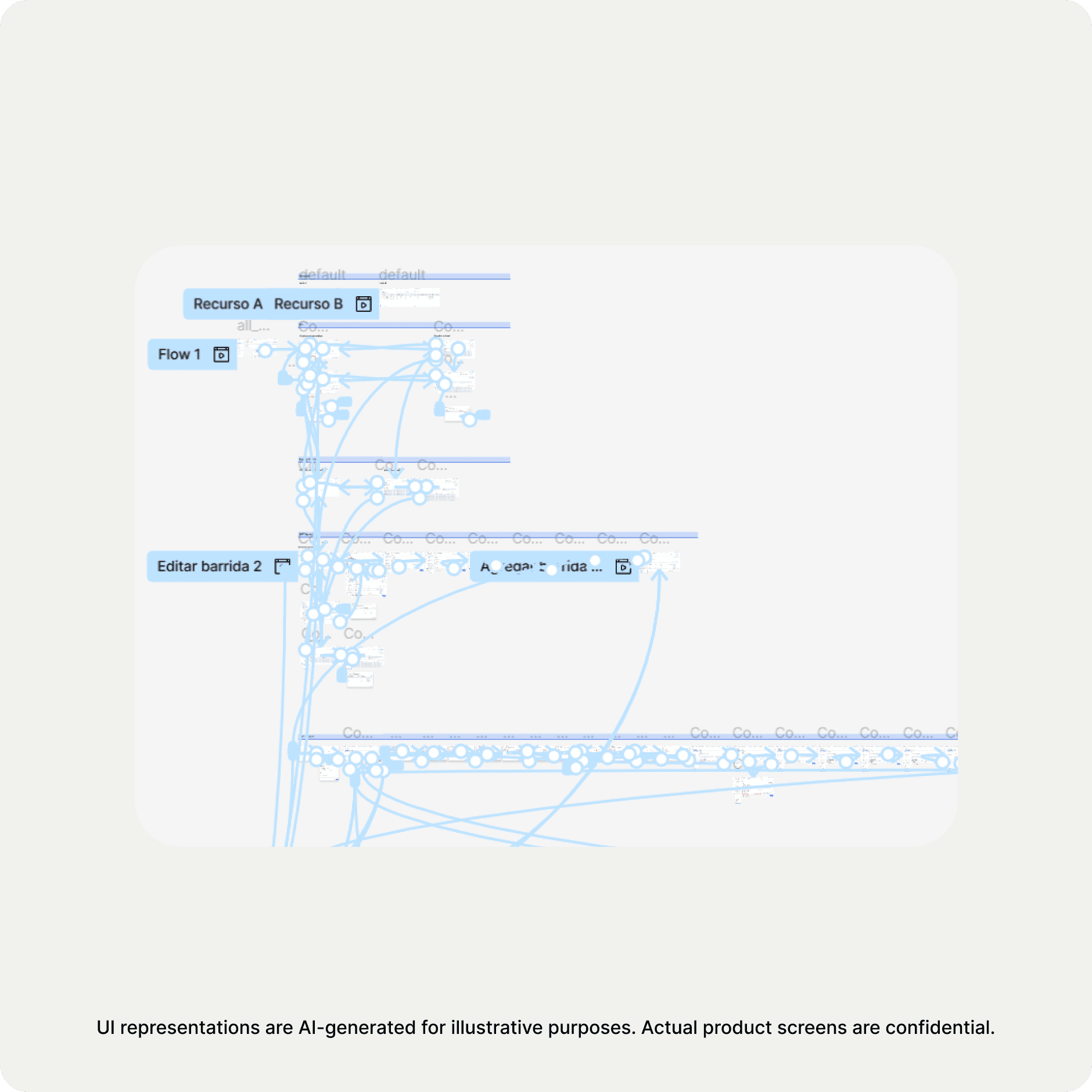
We completely redesigned the core flow to support complex configurations without overwhelming the UI or crashing the system. A modular structure lets users focus on one rule set at a time, improving clarity and performance.
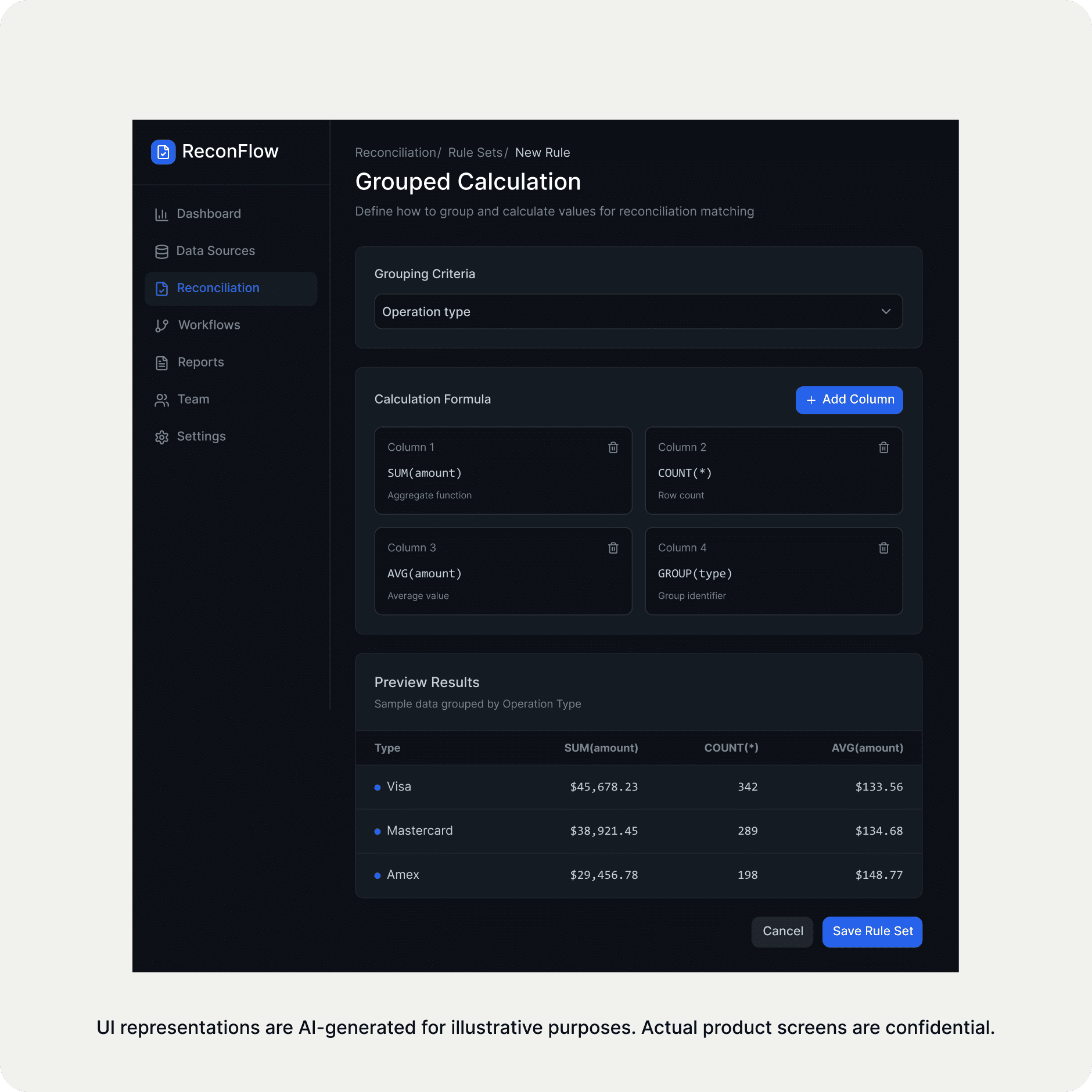
Grouped Calculation (Feature 1)
Users can now group records by defined criteria and apply custom formulas over value columns, replacing a process that previously required up to 15 chained reconciliations with a single, focused configuration.
Self-Reconciliation (Feature 2)
Allows reconciling a resource against itself to handle edge cases like returns or offsets not present in the counterpart, addressing a long-standing gap for power users.
Segmented Rule Sets (Feature 3)
Users can segment records by variables such as brand or operation type to run focused rule sets by group, enabling configurations like Visa, Mastercard, and Amex to be handled independently within the same flow.


Results
Reduced System Instability
Timeout and crash incidents during high-load reconciliation runs dropped by 90%, allowing power users to work with complex configurations without interruption. What previously required 15 chained reconciliations can now be achieved in a single one.
Improved User Confidence
Feedback from frequent users and technical teams was very positive, highlighting clarity, control, and system reliability as the standout improvements of the redesign.